

FAQs About the
Glass City River Wall


Frequently Asked Questions
1) How did this project come about and who spearheaded it?
The idea for the Glass City River Wall began when locals Nicole LeBoutillier and Brandy Alexander-Wimberly took a boat cruise on the Maumee River and noticed that the ADM grain silos are often the first impression of Toledo for visitors. They wondered why the spirit and creativity of the community weren’t reflected on such a prominent canvas. Over the following year, they teamed up with Christina Kasper, who helped form the non-profit organization—formerly known as Urban Sight—that would lead the effort. Christina served as Project Manager, overseeing the complex process of bringing the mural to life, while Nicole managed operations. Together, their collaboration transformed an inspired idea into a powerful and lasting welcome to the city.
2) Was this project done in partnership with The Arts Commission?
The Glass City River Wall was born from the same creative spirit that has long defined Toledo’s dedication to public art. That tradition began in 1977, when Susan Reams championed an ordinance committing one percent of the city’s capital improvement budget to public art, a principle that continues to guide The Arts Commission’s mission today. Although The Arts Commission was not an official project partner, two of its representatives, Susan Reams and Nathan Mattimoe, Art in Public Places Coordinator, served on the project’s steering committee, sharing their expertise and ensuring the organization stayed closely involved throughout the process.
3) How is it a “public” art project if the property is privately owned by ADM?
Although the silos are privately owned by ADM, the Glass City River Wall was a true community art project—created to reflect Toledo’s spirit, celebrate its history, and connect residents through art and education. Local educators and organizations collaborated to develop curriculum opportunities for students, ensuring the project had lasting educational and cultural value. ADM, a global leader in agricultural processing and nutrition, partnered closely with the project team, helping bring this vision to life while contributing to the city’s artistic and economic vitality.
4) How was ADM involved?
In 2019, the project team approached ADM with the concept, and the company quickly became a key partner. Through ADM Cares and the leadership of local facilities manager Jason Boyer, who served on the project’s steering committee, ADM provided both financial and logistical support. In addition to donating the 160,000-square-foot “canvas,” ADM and ADM Cares contributed $125,000 in grants to help launch and complete the mural.
5) How was the artist chosen?
The Glass City River Wall team issued an international Request for Qualifications (RFQ) to identify the lead artist. Among many outstanding applicants, Gabe Gault of Los Angeles was selected for his powerful concept and message of hope. His vision—to honor the region’s original farmers, the Native American women and children, while inspiring abundance and unity for the future—perfectly aligned with the project’s goals.
6) How did an artist from outside the area adapt to working in Northwest Ohio’s conditions?
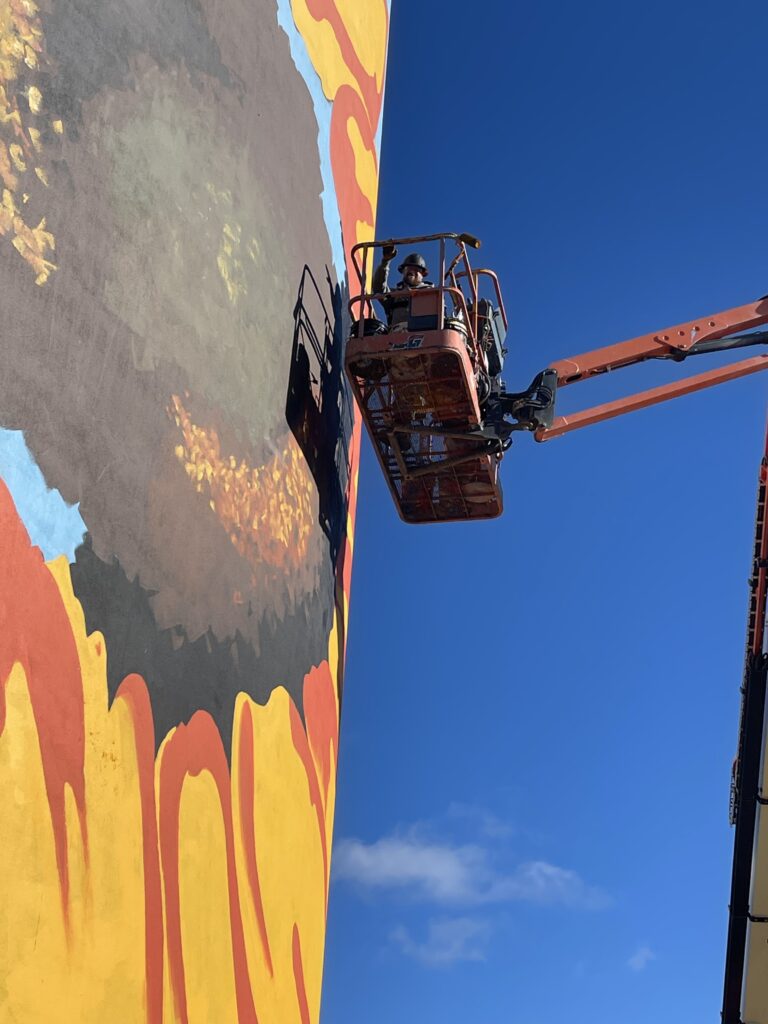
To ensure success, Gault assembled a team with extensive regional experience, including Toledo local artist and Lead Muralist for the project Dean Davis, Ohio-based muralist Eric Henn, and other skilled painters. With over four decades of combined experience painting large-scale outdoor works in the Midwest, the team was well equipped to manage the environmental and technical challenges of the installation. [See the full artist crew here.]
7) What message does the mural convey?
The Glass City River Wall was designed to bring renewal, positivity, and pride to Toledo through art. The mural honors the region’s Native American heritage, highlighting the women and children who were the first agriculturalists of the Maumee River Valley. Gault’s bold, colorful design tells a story that feels deeply rooted in place while inspiring optimism for the city’s future. The work celebrates both the past and present—serving as a vibrant symbol of community, resilience, and growth.
8) How much did the project cost?
The Glass City River Wall began with an estimated budget of $750,000. However, supply chain challenges during COVID-19 and weather-related delays extended the installation to two years, ultimately bringing the total cost to $1.4 million. The project budget covered site preparation, mural production, project management, long-term maintenance, and the creation of an educational curriculum.
9) Is there a maintenance and conservation plan for the mural?
Yes. While the original budget included a maintenance plan, the project’s increased costs meant only a limited fund was available for upkeep. Minor repairs, totaling approximately $5,000, were completed in 2025, three years after the mural’s completion. An advisory committee and artist Gabe Gault continue to work with ADM to support ongoing preservation efforts, ensuring the mural remains vibrant for years to come.
10) When was the project completed?
Phase 1 was finished in August 2021, just before the Solheim Cup, which brought tens of thousands of visitors to Toledo, giving them a striking new landmark along the Maumee River. Phase 2, completing the portraits and extending the mural around the south-end silos, wrapped up in October 2022 with a ceremonial celebration.
11) How was the project funded?
The Glass City River Wall was made possible through a mix of corporate sponsors, foundations, and individual donors. Support came from major local and national companies, arts and family foundations, and community members, all of whom played a vital role in bringing this landmark project to life.

-
Toledo Museum Insider: Your Guide to Current & Upcoming Exhibits
TMA offers a wide range of exhibitions that explore all time periods and regions of the globe! From unique contemporary installations to travelling exhibitions that explore individual artists or historical […]

-
Experience Arts and Culture in Toledo
From a world-renowned art museum to more than 80 works of public art to music, dance and theater, Toledo’s thriving arts and culture scene is one of its most defining features.
-
Fall in Love with Toledo: Your 2025 Autumn Events Guide
From apple picking and Oktoberfest to football rivalries and ghost walks, Toledo has it all this fall.